Colloidal Silver is not one universally identical formula. Products can differ in their labeled concentration, the water and silver used to make them, their manufacturing controls, bottle format, and intended directions. Those concrete details are the most useful place to begin when comparing products. A concentration number, a description such as “colloidal,” or a technical reference should never be accepted as proof of a particular outcome.
The most useful questions are straightforward: What is in the bottle? What concentration appears on the label? Which quality details can be verified? This guide explains those points and separates measurable product information from language that may sound scientific without establishing a particular outcome.
What colloidal means
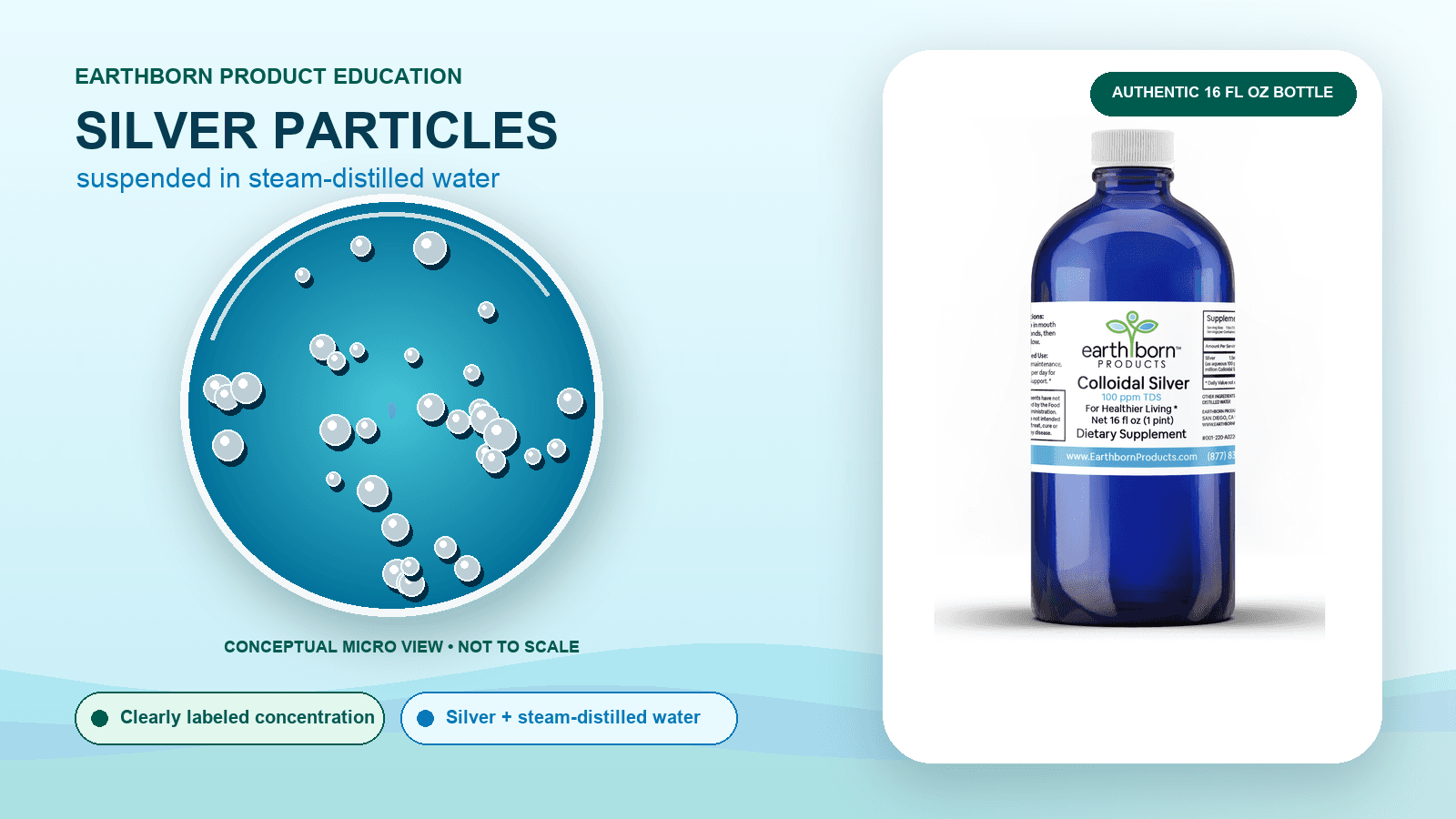
A colloid is a mixture in which very small pieces of one material are dispersed through another material. In a silver-and-water product, silver may be present in particulate and ionic forms, and the relative amounts can vary with the process used. The word “colloidal” describes the type of dispersion; it does not tell a shopper everything about particle size, ionic content, purity, consistency, or intended use.
Earthborn’s current product information identifies silver and steam-distilled water as the product components. It also identifies the purity of the source silver used in manufacturing. Source-silver purity and final-product concentration are two different measurements: one describes the starting material, while the other describes how much silver is represented in the finished water-based product.
Labels and current product pages are therefore more useful than a single marketing term. They let a shopper verify the exact concentration, container size, ingredient statement, directions, and product identity before ordering.
What PPM measures
PPM means “parts per million.” On a Colloidal Silver label, it is a concentration statement: it communicates the labeled amount of silver relative to the finished mixture. Earthborn currently offers product families labeled 100 PPM, 500 PPM, and 1000 PPM.
A higher PPM number indicates a higher labeled concentration. It does not automatically mean that a product is higher quality, a better choice for a particular person, or suitable for the same directions as a lower-concentration product. PPM also does not reveal particle-size distribution, the proportion of particulate silver to silver ions, or the controls used during a specific production batch.
That distinction matters when shopping. Compare like with like: confirm the concentration and bottle size, then read the directions for that exact product. Do not transfer directions from one concentration to another or assume that a larger number is a recommendation.
A practical quality checklist
Useful product comparison begins with details that can be read, verified, or requested. Before purchasing a silver-and-water product, consider the following:
- Product identity: Does the front and back label clearly identify the product and its concentration?
- Ingredient transparency: Are all listed ingredients easy to find rather than implied only through marketing language?
- Size and format: Is the container a standard bottle, spray, larger refill size, or concentrated product with different directions?
- Lot information and seal: Does the physical bottle arrive sealed and carry the lot or production information used by the manufacturer?
- Current directions: Are you reading the label on the bottle you are actually purchasing, rather than an old article, archived photograph, testimonial, or third-party listing?
- Seller accountability: Is there a real company contact for questions about ordering, packaging, labels, and product identity?
- Documentation: If a seller makes a specific measurable quality statement, can it explain what was measured and how that statement is supported?
These checks are more dependable than broad phrases such as “premium,” “advanced,” or “best.” They also make it easier to compare products without turning a quality discussion into an unsupported promise.
Clarity, color, and particle claims
Clear appearance, particle size, production method, and comparisons with yellow or darker products are often discussed when shoppers compare Colloidal Silver. Appearance can be documented as an observation, but visual clarity alone is not a complete laboratory analysis. A shopper cannot determine concentration, particle-size distribution, ionic content, purity, consistency, or product performance simply by looking through a bottle.
For the same reason, descriptions such as “monatomic” should not be used as shortcuts for absorption or effectiveness claims. When particle characteristics matter to a purchasing decision, the responsible question is what analytical documentation supports the specific statement—not whether a familiar technical word appears in promotional copy.
Why catalyst language needs context
A catalyst is generally a material that affects the rate of a chemical reaction without being consumed in the same way as a reactant. That general chemistry definition is not controversial. The important issue is what conclusion someone tries to draw from it.
Silver is discussed in contexts that include water purification, engineered systems, and laboratory research. Those are not clinical studies of an Earthborn dietary supplement, and they do not establish a mechanism or outcome in the human body. A proposed interaction in one setting should not be presented as a settled product fact in another.
Scientific context should match the claim being made. A water purification reference can help explain why silver has been studied in engineered systems. A laboratory experiment can describe what happened under its exact conditions. Neither should be converted into personal-use guidance without appropriate evidence specific to that question.
Compare Earthborn options
Earthborn organizes its current silver-and-water products by concentration and package format. Use each current product page to confirm available sizes, pricing, photographs, and directions:
- Colloidal Silver 100 PPM is the standard product family and is offered in multiple bottle sizes.
- Extra Strength Colloidal Silver 500 PPM is a separately labeled higher-concentration product.
- Colloidal Silver 1000 PPM Concentrate is a distinct concentrated product whose own label and directions should be reviewed carefully.
The purpose of showing these options together is identification, not personal recommendation. Check the exact item selected in the size and checkout controls, and confirm that the cart displays the matching bottle image, concentration, size, and price before completing an order.
Responsible use
Use only the directions on the current label for the exact product purchased. General educational content, customer stories, search-engine summaries, social posts, and third-party marketplace descriptions should not replace the bottle label or advice from a qualified professional.
Earthborn’s educational pages describe composition, concentration, packaging, and product choices. They are not medical advice and do not establish that a product is appropriate for a particular person, animal, condition, or medication routine. For personal-use questions, consult a qualified healthcare professional; for animal-specific questions, consult a veterinarian.
Regulatory context also matters when evaluating online claims. In 1999, the U.S. Food and Drug Administration published a final rule addressing over-the-counter drug products containing Colloidal Silver ingredients or silver salts. This page therefore keeps industrial references and proposed mechanisms separate from product outcome claims.
Questions Earthborn can answer
Earthborn can help with practical product questions: which bottle sizes are currently available, which concentration appears on a listing, what packaging format is shown, whether an order contains the selected variant, and how wholesale or private-label inquiries are handled. Use the contact page when a label, size, image, shipment, or order detail needs clarification.