Colloidal Silver is a water-based product in which silver is present in dispersed forms. That short definition is a useful starting point, but the word colloidal does not tell a shopper everything about a product. It does not, by itself, identify the labeled concentration, ingredient statement, package size, production controls, particle characteristics, or directions.
A clearer way to understand the category is to separate three questions: What does “colloidal” mean? What does the concentration number mean? Which details can be checked on the current label and product page? This guide walks through those questions without turning technical language into promises about personal outcomes.
Quick definition: In this context, “colloidal” describes silver dispersed through water. The exact composition can vary by product and process, so the current label remains the most practical source for product-specific information.
Start with the word “colloidal”
A colloid is a mixture in which very small pieces of one material are dispersed through another material. Milk, fog, and some paints are familiar examples of colloidal systems, although their ingredients and physical behavior are very different from a silver-and-water product.
“Dispersed” is not the same as saying that every silver component has dissolved into the water. Depending on the process and product, silver may be present in particulate and ionic forms. The balance between those forms cannot be determined from the product name alone.
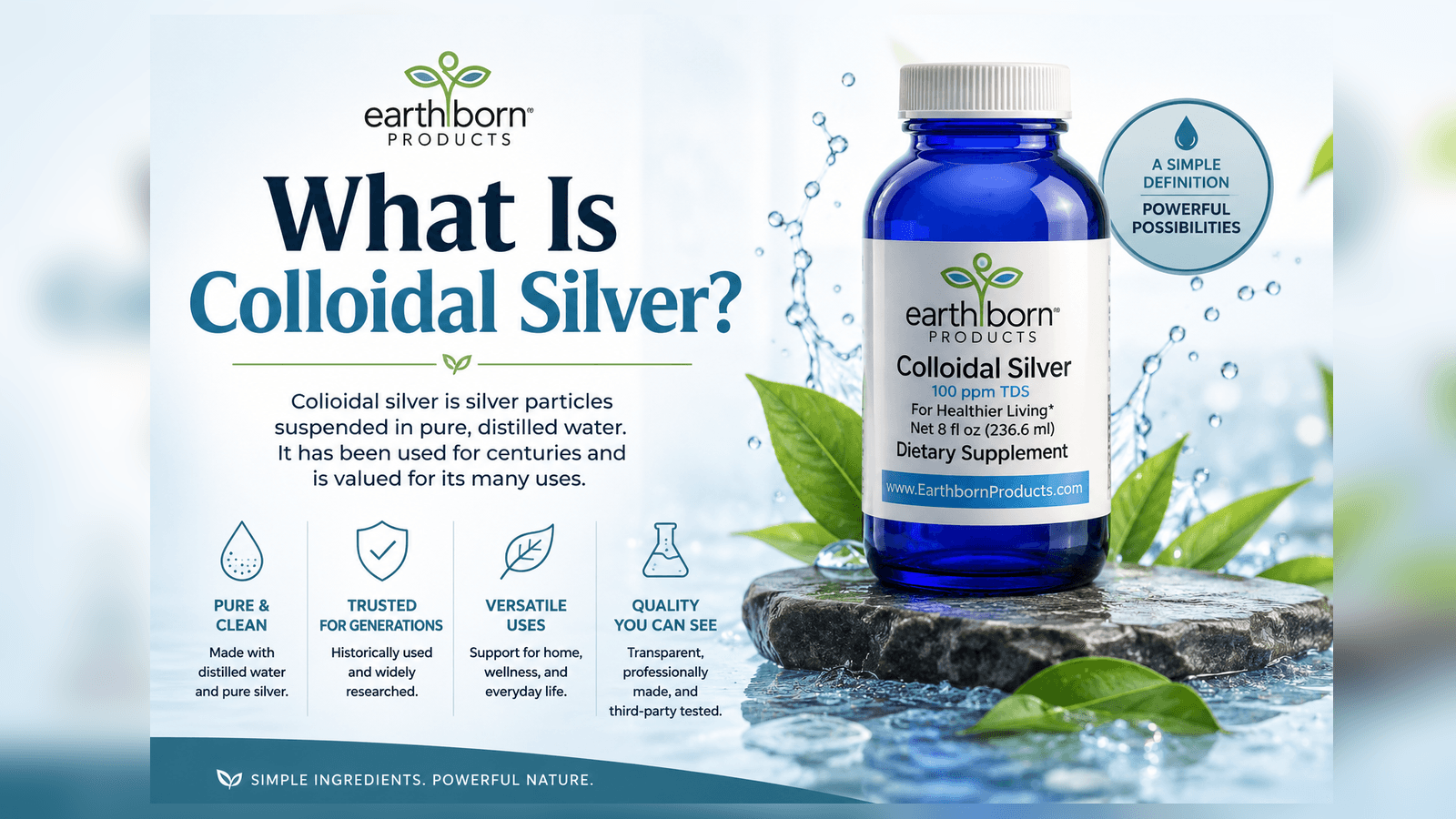
The particle illustration in the hero above is therefore conceptual and not to scale. It helps communicate the idea of a dispersion; it is not a laboratory image, particle-size measurement, or representation of a specific production batch.
What is in a silver-and-water product?
Earthborn’s current product information identifies silver and steam-distilled water as the components of its standard Colloidal Silver product. It also identifies the purity of the source silver used during manufacturing. These are useful facts, but they describe different parts of the product story.
Source-silver purity describes the material used to make the product. Finished-product concentration describes how much silver is represented in the completed water-based mixture. Neither number should be substituted for the other.
Other brands and formulations may use different processes, ingredient statements, concentrations, or package formats. That is why category-level explanations should always lead back to the exact bottle under consideration.
What PPM tells you
PPM means parts per million. On a Colloidal Silver label, PPM is a concentration statement. Earthborn currently organizes its silver-and-water products into product families labeled 100 PPM, 500 PPM, and 1000 PPM.
A higher number indicates a higher labeled concentration. It does not automatically mean “better,” establish a preferred choice, or make the directions interchangeable. Each concentration should be considered its own labeled product, with its own current listing and instructions.
PPM also does not reveal every characteristic of a mixture. It does not, by itself, report particle-size distribution, the proportion of particulate silver to silver ions, or the controls used for a specific batch. For a deeper explanation, read Understanding Colloidal Silver: Composition, PPM, and Quality.
Why appearance alone is not enough
Shoppers often notice whether a product appears clear, yellow, brown, or darker. Appearance is a real observation, but it is not a complete analysis. Looking through a bottle cannot establish concentration, source purity, particle-size distribution, ionic content, consistency, or product performance.
Technical descriptions such as “monatomic” should be approached in the same careful way. A familiar scientific word is not a substitute for analytical documentation, and it should not be used as a shortcut for absorption or outcome claims.
Storage and handling should also come from the current label. Avoid assuming that color, bottle material, or a marketing phrase proves that a product does—or does not—need particular handling.
A practical comparison checklist
When comparing products, begin with information that can be read or confirmed:
- Product identity: Does the label clearly name the product and concentration?
- Ingredient statement: Are the listed components easy to locate?
- Bottle size: Are you comparing the same bottle volume and the same package format?
- Current directions: Are the instructions from the exact bottle being considered?
- Photos and selection controls: Does the chosen size match the image, price, and cart line?
- Seal and lot information: Does the physical product arrive sealed with identifying production information?
- Company contact: Can the seller answer practical questions about labels, sizes, packaging, and ordering?
This approach is more dependable than comparing broad words such as “advanced,” “premium,” or “best.” It gives shoppers a repeatable way to evaluate product information without mistaking promotional language for evidence.
Our Product: what makes Earthborn different
Ready to move from the general definition to Earthborn-specific details? Visit Our Product to read the article titled What Makes Ours Unique. It brings together Earthborn’s product presentation, quality points, ingredient simplicity, packaging information, and responsible context in one place.
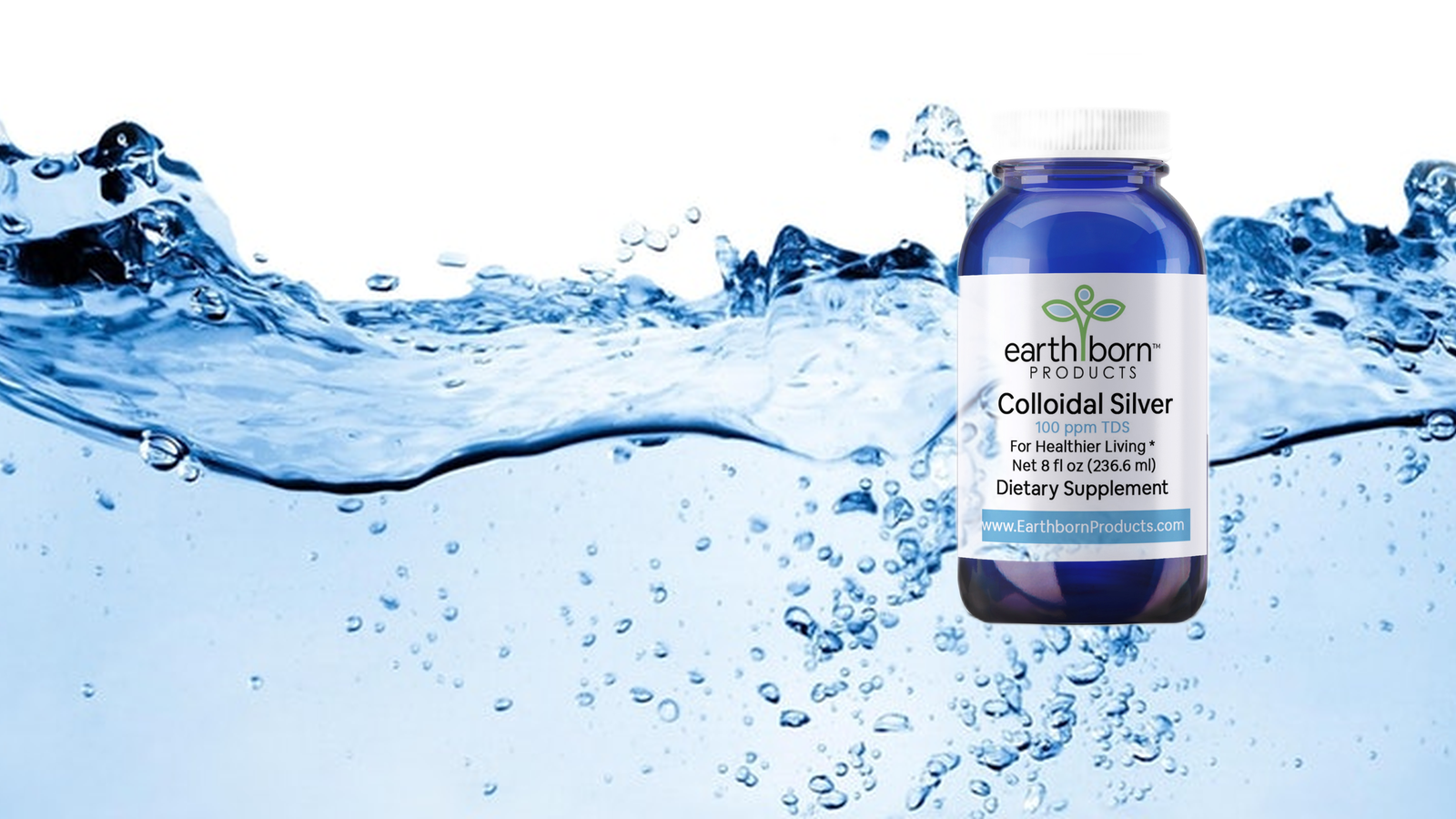
For current sizes, prices, bottle photographs, and selection controls, use the Colloidal Silver 100 PPM product page. Product pages should be used for current ordering details; educational articles are best used for definitions and comparison guidance.
Responsible next steps
Educational content can help a shopper understand terminology, concentration, package formats, and label information. It cannot determine whether a product is appropriate for a particular person, animal, condition, or medication routine.
Use the directions on the current label for the exact product purchased. For personal-use questions, consult a qualified healthcare professional; for animal-specific questions, consult a veterinarian.
Earthborn can help with practical questions about bottle sizes, concentrations, product photographs, packaging, orders, shipping, and wholesale or private-label inquiries. Use the contact page whenever a product or order detail needs clarification.